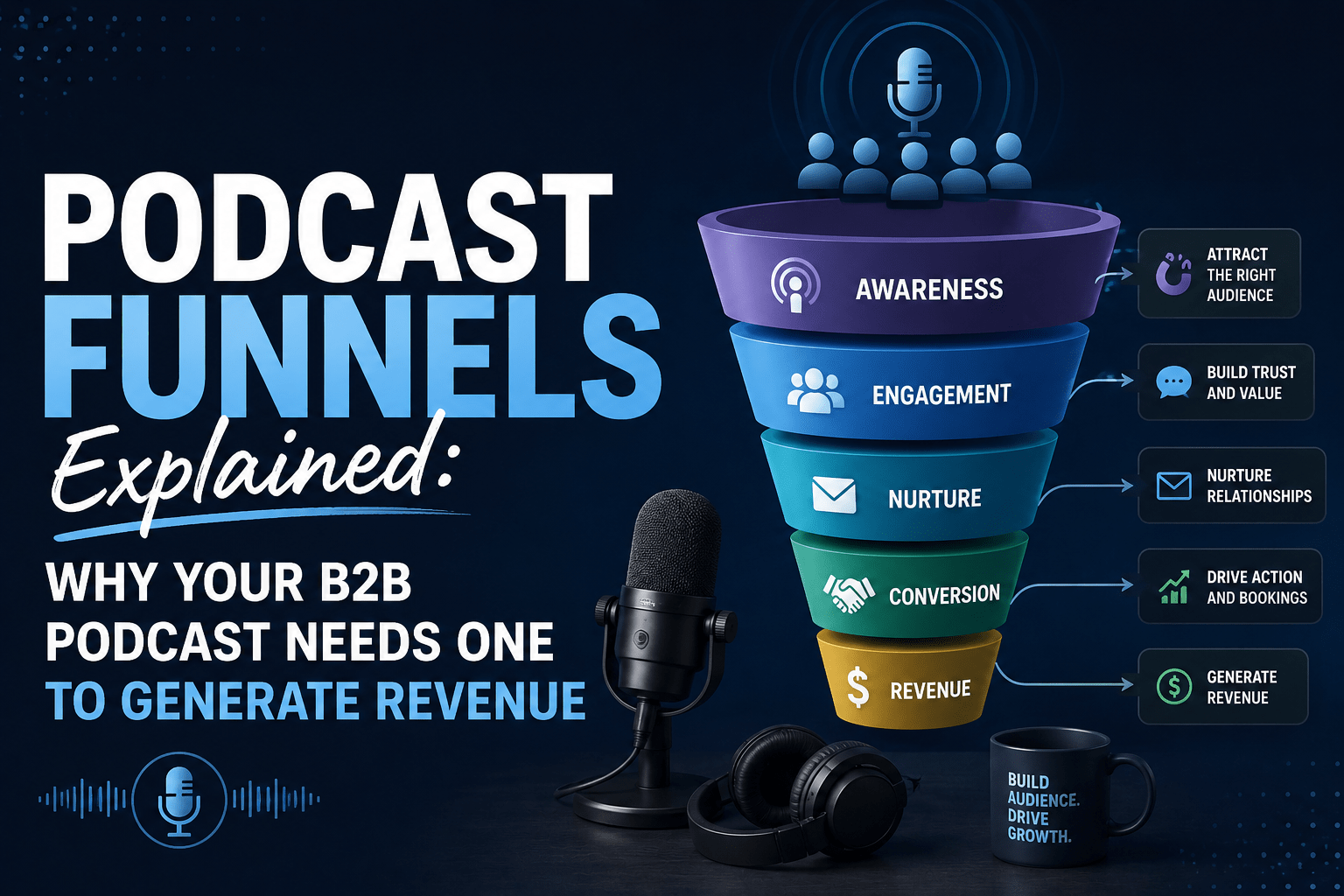
A podcast funnel is the deliberate path you create between a first-time listener and a paying client. Without one, your podcast is a content asset with no commercial architecture, people listen, enjoy it, and move on. With one, every episode becomes an entry point into a system that builds trust, captures interest, and converts it into revenue. For B2B founders, understanding and building a podcast funnel is the difference between a show that feels good to produce and one that actually grows the business.
Most B2B Podcasts Don’t Have a Funnel—They Have an Audience
There’s a version of B2B podcasting that looks productive on the surface. Episodes go out regularly. Download numbers creep up. Guests share the show with their networks. The host gets recognized at industry events. But when someone asks what the podcast has actually generated in terms of revenue or pipeline, the answer is vague at best. This is the audience trap. An audience is not a funnel. An audience is a group of people who like what you make. A funnel is a system that moves people from awareness to action. You can have one without the other, but only one of them generates revenue.
The reason most B2B podcasts fall into this trap is that the advice available to founders is mostly about production — recording quality, publishing cadence, and interview technique. Very little of it addresses the underlying commercial architecture. How does a listener become a lead? What happens between the moment someone discovers your show and the moment they book a call? If you can’t answer that question with a clear sequence of steps, you don’t have a funnel yet.
What a Podcast Funnel Actually Looks Like
A podcast funnel has three layers, and each one does a different job.
-
Layer One: Awareness and Trust
This is the podcast itself. Every episode you publish is doing awareness and trust-building work. A founder who listens to ten episodes of your show knows your thinking, your values, your approach to their problem, and your opinion on their industry. That level of familiarity is almost impossible to replicate through a website, a LinkedIn profile, or even a referral. It’s why podcast listeners convert at higher rates than other content audiences, they’ve already spent hours with you before you’ve ever spoken.
The job at this layer is to be genuinely useful and opinionated. Generic interview content with safe takes does not build the kind of trust that converts. Content that challenges assumptions, shares real client scenarios, and takes a clear point of view on what good looks like — that’s what moves someone from casual listener to someone who wants to work with you.
-
Layer Two: Capture and Nurture
Most podcast funnels break here. A listener finishes an episode, feels genuinely interested in your work, and then… nothing. There’s no next step that pulls them closer. They go back to their day, and within 48 hours, the connection has faded.
The capture layer is where you convert a listener into someone you can continue the relationship with. That might be an email list, a private community, a newsletter, or a gated resource. The mechanism matters less than the principle: you need a way to stay in contact with people who are interested but not yet ready to buy.
Nurture is what happens once they’re in your ecosystem. Email sequences, follow-up content, case studies, and live events all serve the same purpose — keeping your thinking front of mind for buyers who are in a slow research phase. B2B buying cycles are long. The founder who isn’t ready for a conversation today may be ready in six months, but only if you’ve maintained the relationship in the meantime.
-
Layer Three: Conversion
This is where the commercial outcome lives. A conversion in a B2B podcast funnel is rarely an impulse purchase — it’s typically a booked call, a completed inquiry form, or a direct message that starts a sales conversation. The job of this layer is to make that action as easy and obvious as possible for someone who is ready to take it.
Most founders underestimate how much friction exists at this layer. A listener who wants to explore working with you should be able to go from that thought to a booked meeting in under two minutes. If they have to hunt for a contact page, navigate a confusing services menu, or send a cold email into a generic inbox, a meaningful percentage of them won’t bother.
Why Founders Resist Building the Funnel
The most common reason B2B founders don’t build a podcast funnel is that it feels at odds with the spirit of the show. For many hosts, podcasting is about genuine conversation and thought leadership — not selling. The idea of attaching a commercial architecture to that feels like it cheapens something they care about. This is a false tension. A funnel doesn’t make your content less genuine. It doesn’t mean every episode needs to end with a hard sell or that your interviews become infomercials. It simply means that when someone is ready to take the next step with you, there’s a clear path for them to do it.
The second reason is that building the funnel feels like a separate project from making the podcast — and for founders who are already stretched thin, another project is hard to prioritize. But the funnel doesn’t require a complex tech stack or a dedicated marketing team. In its simplest form, it’s a good CTA, an email signup page, and a booking link. That’s a morning’s work, not a quarter-long initiative.
The third reason, and the most damaging, is that founders assume the funnel will build itself if the content is good enough. It won’t. Quality content is necessary but not sufficient. Without deliberate commercial architecture, great content produces great listeners, not great clients.
The Strategic Case for Building Your Funnel Before You Need It
One of the most counterintuitive things about podcast funnels is that the best time to build them is before your audience is large enough to justify it. Founders often tell themselves they’ll add the commercial layer once the show has grown. But a show with 500 engaged listeners and a strong funnel will consistently outperform a show with 5,000 passive listeners and none.
The reason is compounding. Every listener who enters your funnel early becomes a longer-term relationship. Every email subscriber you capture in month two is someone who might convert in month eight. If you wait until month six to build the capture layer, you’ve lost four months of relationship-building with people who were already interested enough to listen.
There’s also a practical argument about data. A funnel gives you a signal. You can see which episodes drive the most email signups, which CTAs get clicked, and which pieces of content push people towards booking a call. Without that data, you’re making content decisions based on download numbers alone, a metric that tells you almost nothing about commercial intent.
How the Funnel Changes the Way You Think About Content
Once you have a funnel in place, your approach to episode planning changes in a useful way. Instead of asking “what would be interesting to talk about this week?”, you start asking “where is this listener in the buying journey, and what do they need to hear to move forward?”
Some episodes should be pure awareness content — broad topics that bring new listeners in and introduce them to your worldview. Others should be deeper conviction content, specific, opinionated takes that resonate strongly with people who are already familiar with your work and are starting to consider whether you’re the right partner for them. And some episodes should be conversion-adjacent case studies, client results, process breakdowns that give a ready buyer the final confidence to reach out.
This is what separates a podcast strategy from a podcast hobby. A strategy is designed to move people. A hobby is designed to express something. Both can produce great content, but only one produces great clients.
Who This Applies To
The podcast funnel model works best for B2B service businesses, SaaS companies with a consultative sales process, and founders who are the primary face of their brand. If your business relies on trust, expertise, and relationship-driven selling — and most B2B businesses do — then a podcast is one of the most effective trust-building tools available. The funnel is what turns that trust into a commercial outcome.
It’s less relevant for purely transactional businesses where purchase decisions are made on price or availability alone. But if your buyers need to understand your thinking, trust your judgment, and believe you’re the right fit before they’ll commit, a podcast funnel isn’t a nice-to-have. It’s the strategy.
Ready to Build a Podcast That Actually Converts?
At Podcast FastTrack, we help B2B founders build podcasts with the commercial architecture built in from day one, not bolted on later. If you want to see what a podcast funnel designed around your specific business model looks like, book a free strategy call. We’ll map out the full picture.